









While colleges use standardized testing to gauge a student’s academic potential, the SAT does not. The College Board created the SAT in 1926 to test innate intelligence. As time passed, the SAT strayed away from its original purpose. The modern era of standardized testing seems to represent a class barrier more than anything else.
Claude Steele conducted a study that found that the SAT measures only about 18% of a student’s academic potential. The SAT itself is not a good indicator of a student’s success in college.
One reason the SAT is inadequate for measuring academic ability is that it only tests up to Algebra 2 in math. Many students who take this test have surpassed this level of math and have to review the math they no longer use.
“The math section is up to Algebra 2 and pre-calculus, and I don’t think that’s very fair. I feel like the SAT should be based on how much you know overall,” Camas High School (CHS) junior Anthony Do said. “So it should be changing based on how well you’re answering the questions, and then if you can answer those questions well enough, that’s a more accurate reflection of how good you are at math.”
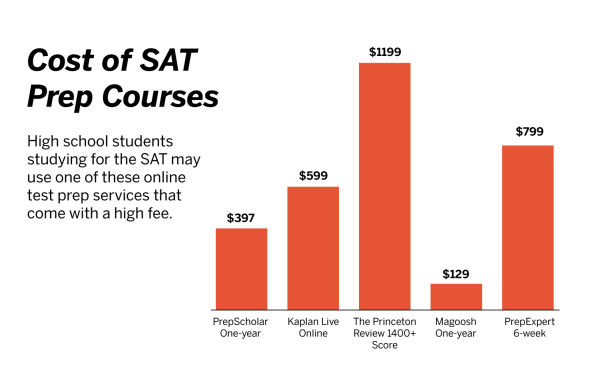
Self-studying for the SAT will only cost around $200. This cost mainly includes textbooks. However, test takers know this is not the most effective way to prepare.
According to PrepScholar, Students can expect to pay up to $2800 for a full 40 hours of preparation through online courses and textbooks. Even doing this would only be considered entry-level, as in-person courses can cost up to $3600 for the same amount of time, and personal tutoring can cost $8000.
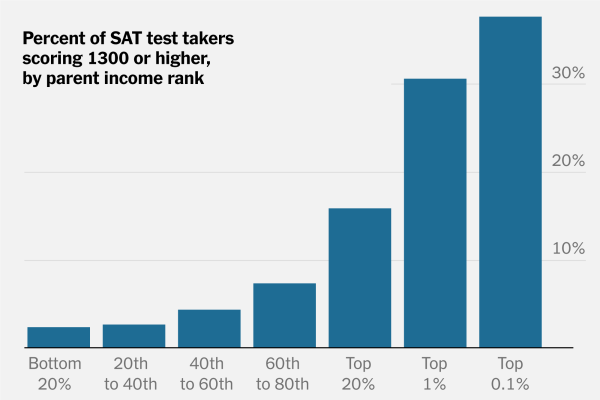
While it is not required to do so, studies show that wealthier students with the resources to spend on SAT prep score significantly higher than those who do not. Researchers at Harvard found that the bottom 20% of the income distribution have a 2.5% chance of scoring a 1300 or higher on the SAT.
“The richer you are, and the more resources that you can afford and have access to, will impact your score really heavily,” CHS senior Orrin Brown said. “If you can afford tutoring, you’re obviously going to get a way higher SAT score than someone who can’t.”
“There are so many programs that you could use to study for the SAT, most of which cost money, and some people don’t even have access to the internet. Some people don’t have enough money to pay for those websites or those subscriptions,” Do said. “It’s not fair. I mean, there should be some form of studying accessible to everybody to accurately gauge how smart you are.”
“I think making SAT prep resources more accessible to lower-income communities could definitely level the playing field for the test,” Brown said.