








Artificial intelligence (AI) usage in schools is on the rise, but the Camas School District (CSD) has yet to establish a clear policy regarding its place in the classroom. Parents and students alike have shared concerns about how AI is being managed at Camas High School (CHS), yet there remains no definitive answer.
“There is no current policy for CHS,” CHS Principal Kelly O’Rourke said. “However, the district is currently working on one. There is a citizen advisory committee with the district that’s been meeting to talk about possible policies.”
There have been other school districts in the United States that have developed AI policies of their own. For instance, Holliston Public Schools in Massachusetts has developed a policy that covers how to use it, how to evaluate work produced with AI, how staff should manage AI in lessons, and penalties for AI misuse.
Somerville Public Schools in New Jersey also have a notable policy that covers similar topics to Holliston. The policy goes over ethical use and how to cite AI in research papers.
In the Pacific Northwest area, Tigard-Tualatin School District has a comprehensive, in-depth guide on AI usage.
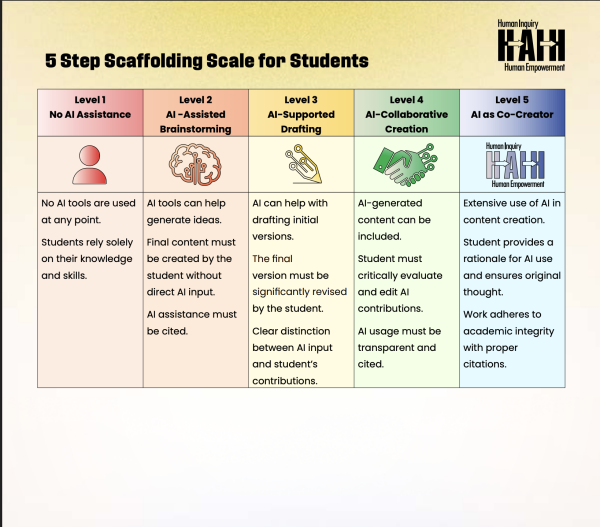
In Washington, AI policy is up to the school to decide how it is managed. However, the Washington Office of Superintendent of Public Instruction (OPSI) posted its own guide as a template Washington schools can follow.
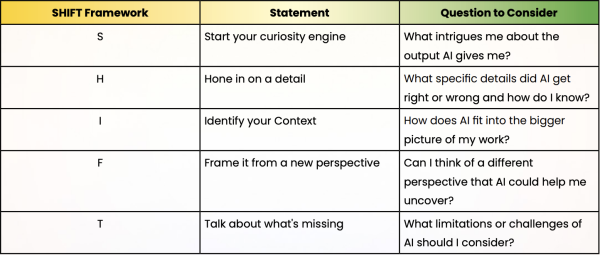
The 54-page document provides many resources for the school to use, including: a five-step scale on the amount of AI a student should use during an assignment, a framework acronym for student critical thinking about AI, ethics of AI, ethical use of AI, AI usage in different subject areas, and many more discussions on AI usage in schools.
Due to Camas still having no definitive policy, thoughts on AI usage have been divisive. Some believe it to be a tool to assist in learning.
“Let’s say I’m in calculus. I’m like, man, that problem was so hard. I don’t understand. The teacher explained it, but I still don’t understand it,” Assistant Superintendent Derek Jaques said. “Now I can maybe ask AI, can you break this down and explain the parts of it? So maybe I understand the pieces that I didn’t get to make my overall learning better.”
Others reject the idea as a whole.
“[AI] shouldn’t be allowed in the classroom,” CHS junior Lillian Kerr said. “I believe that in school, children should be working on their own education and betterment of their skills, and the use of an AI shortcut gets rid of the necessary skills they are supposed to be building.”
If students are to integrate AI into their daily learning, CHS staff believe we must educate students on how to use it effectively and integrate it into class learning.
“I think it’s our responsibility that we need to start teaching students how to use it,” O’Rourke said.
“I feel like we need to provide opportunities and have open dialogues and discussions around why we would use AI here? Why wouldn’t we use AI?” Sam Greene, CHS teacher, said.
“I am one of the 80/20 people. 80% AI, 20% human; there has to be a human part of it for it to work. You can’t totally trust AI; it’s a large language model, not a person,” CHS librarian Tonia Albert said. “[AI] is a tool, and it depends on how you use it. I think the whole point of it is to just be super transparent with its use. Especially for teachers because it is a time saver for them.”
AI has also been viewed as a crutch that students may rely on too heavily.
“If you get so used to using it for your homework and then you sit down to take a test, now you don’t even know where to start at all, because you’ve had that crutch,” O’Rourke said.
“I don’t think there should be a policy against it; it’s your decision to abuse it; you’re just not gonna learn the subject.” CHS senior Tyler May said.


