






The Math, Science, and Technology (MST) magnet program at Camas High School held its annual senior research symposium on Dec. 8. Students presented the results of their summer internship projects, spanning a wide variety of topics including environmental science, computer technology, cellular biology, and medical sciences.
For each project, MST seniors, alongside professional mentors, summarize their work into a formal research project, sharing their results and the process behind them.
MST teacher and research coordinator Brianna Abraham said the program is designed to mirror a real-world academic and professional environment.
“I think the greatest strength in the MST program for preparation for college or careers is the soft skills that students learn,” Abraham said. “Collaboration, negotiation, active listening, planning, execution, organizing long-term projects, and learning how to face failure can all be learned through their internships.”
Abraham added that while the technical research offers a valuable example of careers in math and science fields, the broader lessons are just as important, if not more.
“Working alongside adults in a real-world scenario where, if you’re late to work, they’re going to tell you not to come in again … those kinds of things are huge,” Abraham said. “Seeing the consequences of different actions and adjusting to a professional setting is a big helper to future success.”
Despite her years of teaching in the program, Abraham is still impressed by student projects year after year.
“I’m blown away every year,” Abraham said. “Students are doing things I have no expertise in at all, and it’s incredible to see what they’re capable of.”
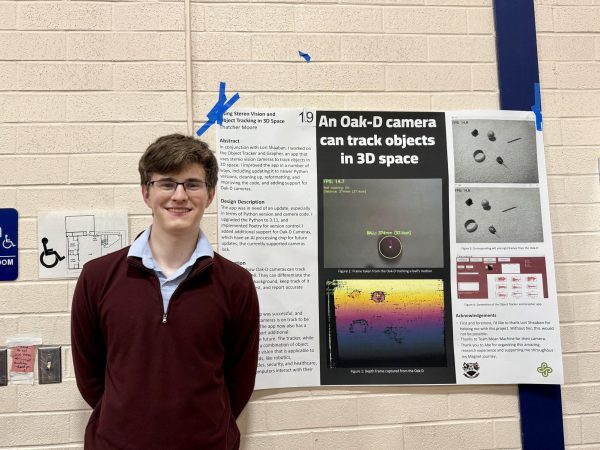
Senior Thatcher Moore presented a project involving object tracking in a three-dimensional space using a specialized camera and software application. The system detects objects, measures their distance and movement, and produces data.
“It can look at an object and see it move around and give data on where it is,” Moore said. “It uses a special camera to figure out how far away it is.”
Moore said a lot of his work involved modifying and expanding on existing code rather than starting from a blank slate, which presented unique challenges.
“I had to jump in the middle and figure out what was already going on,” Moore said. “That taught me how to work with code I didn’t write.”
Along with the technical skills, Moore also added that the experience strengthened his ability to communicate and collaborate with a team.
“I had to work with my mentor and other students, so communication was huge,” Moore said. “Learning from other people in the magnet program has pushed me further than I ever thought I’d be.”
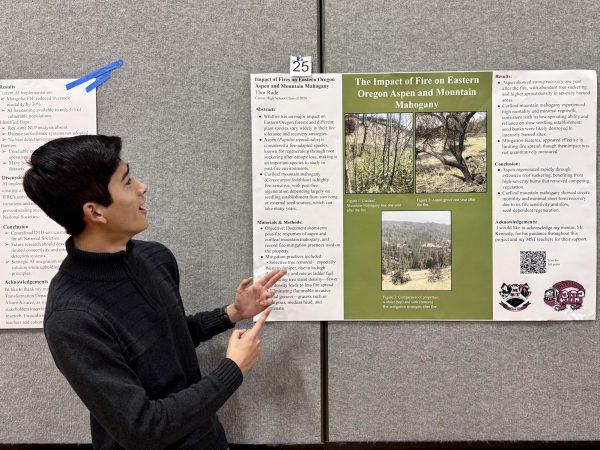
Another senior, Thor Rude, focused his research on ecological effects of wildfires in eastern Oregon. His project compared fire-tolerant aspen trees with fire-intolerant mountain mahogany trees. He also examined the effectiveness of some fire mitigation strategies, like removing undergrowth and reducing tree density.
“Aspen is well known for being very fire tolerant, meaning it can recover quickly after fire,” Rude said. “Mountain mahogany is very fire intolerant, and what we observed was that it had a very high mortality rate.”
Rude also found that areas where mitigation strategies were used exhibited clear differences in tree density and survival rates compared to land where mitigation strategies were not used.
Rude plans to study aviation following high school. However, he finds that the skills he gained through the research process will remain extremely valuable to him.
“It taught me accountability and being on top of my work,” Rude said. “Those skills can be used in college, in the workforce, or really anywhere.”
Yvonne Yin is a senior who presented her research on how epidermal growth factors and signaling molecules affect calcium signaling in PC12 cells, which are commonly used in neuroscience research.
“EGF is a growth factor known to promote cell regeneration,” Yin said. “By studying the calcium response, we can infer whether certain peptides activate similar or different signaling pathways.”
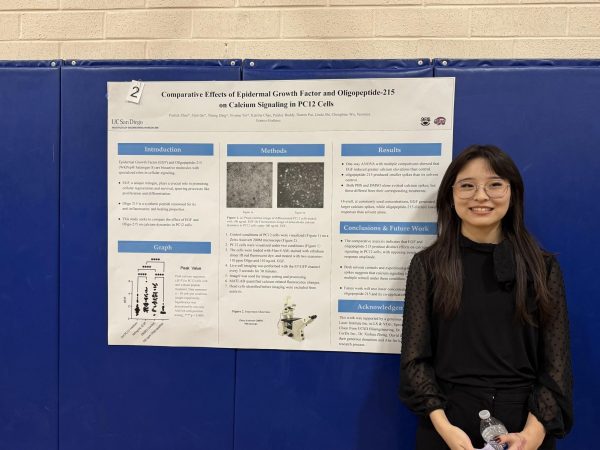
Yin found that presenting her work to professional audiences helped her grow as a researcher and communicator.
“We presented at national and international conferences,” Yin said. “That taught me how to explain my work to professionals and communicate clearly.”
She also credited the MST program with providing the structure and resources needed to pursue advanced research.
“Without the MST program, I wouldn’t have been able to devote myself over the summer to this project,” Yin said. “I learned chemistry, biology, work ethic, teamwork and how to communicate with mentors.”
Abraham shared that one of the strongest assets of the MST program is not just producing research, but preparing students for life beyond high school, whatever they decide to pursue next.
“Whether students discover something they love or something they hate, that’s valuable information,” Abraham said. “The process of learning how to work, communicate and adapt is what stays with them.”