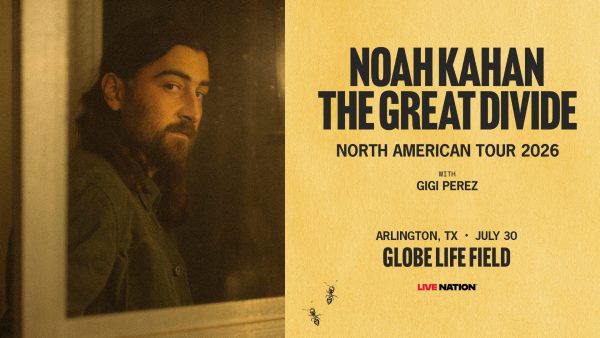
On Friday, April 24, Noah Kahan released his fourth studio album after a long anticipated wait. The Great Divide and its closely followed deluxe The Last of the Bugs had been teased by Kahan for nearly a year before its release. The Great Divide maintained Kahan’s usual melancholy and bittersweet sound while also taking on a more upbeat instrumental.

Following his sudden rise to fame in 2022 due to the internet popularity of his single Stick Season, Kahan struggled to break free from the stereotype as just another TikTok artist, despite having released studio albums prior. The Stick Season album was released in 2022, which Kahan followed up with two deluxe versions in 2023, meaning fans waited three years for fresh content.
The Great Divide is just that. Fresh, summery, and tortured. Kahan has a reputation for writing songs filled with bittersweet emotions involving both hard-hitting topics and more relatable experiences. In his prior albums, he talks about living with family addiction, divorce, and resentment. The Great Divide continues to explore these topics, yet brings a new perspective of what happens after he has left it all behind. This 17 track album radiates guilt, the burden of fame, and the pain of moving on.
The melodies take on a brighter and more upbeat sound with equally devastating lyrics. As opposed to his previous albums, listening to The Great Divide unshuffled sounds like one continuous story with different narrators, fully immersing listeners into all of the layers of Kahan’s experiences.
Kahan kicks off the album with “End of August,” which opens with soothing sounds of nature. It places his audience on a hot, New England summer night.
“The minute that September hits
I’m going off my medicine, oh
Late August Angst, and a
Pointless night”
“End of August” begins with slow instrumentals, making it a controversial choice for an intro song, but eventually picks up speed, mimicking a style used by Kahan in his last single of the Stick Season album, “Forever.”
Following “End of August,” Kahan quickens the melody with “American Cars.” This song introduces the first alternative perspective in the album. It seems to assume the roles of Kahan’s parents or siblings, by expressing how grateful they are to see him again while also exploring their resentment he left in the first place.
“But you’re home, and I’m so grateful you are
‘Cause you’re gonna fix it
You’re gonna patch it up
Honey, we’re fragile
You’ve always been so tough”
“American Cars” illustrates the burden of being a provider, especially as a child with multiple siblings. The line “You’ve always been so tough,” sticks because it shows that Kahan’s family views him as the strong one, with the power to fix everything, which is a burden that he makes evident throughout the album.
Kahan surprised everyone by following The Great Divide immediately with the release of the deluxe, The Last of the Bugs, which contained one of his most famous unreleased songs, “Staying Still.”
“I try to keep on starting over
I’m sleepin’ in a bed half empty, daydreamin’
All love, must leave, oh, but search for it I will
Honey, tell me, are you good at stayin’ still?”
The title song, “The Great Divide,” was initially released as a single, giving fans their first taste of what the album may bring.
“You know I think about you all the time
And my deep misunderstanding of your life
And how bad it must have been for you back then
And how hard it was to keep it all inside”
Kahan reminisces on a childhood friend who turned to religion after a traumatic life, as well as his own regrets at not understanding their struggles when they were young. It sets the mood for the album with conflicting emotions of guilt and hopefulness, bringing meaning to the album’s title, which is meant to describe Kahan’s separation from his life before stardom.
The album slows down slightly with “Willing and Able,” once again shifting the focus onto Kahan’s family as he opens up on his relationship with them after his rise to fame.
“Oh, we can fight like we used to fight
Bony-limbed, red-faced, and teary eyed
Under the glow of the TV light, oh I wish you could know me”
Kahan’s lyrical ability is very evident in “Willing and Able” with his creative and descriptive metaphors and symbolism.
Kahan brings strong vocals and acoustic string work to “Dashboard,” which quickly gained popularity online. While other songs represent Kahan’s motivation for leaving home and the freedom he experienced afterward, “Dashboard” strictly speaks on the blame and anger he felt from his family.
“Just when you think that the road’s straight ahead
Is when the devil shows up on your dashboard again
Look at you go, crossin’ state lines with your shadow
Trying to run away, change your zip code
Turns out, you’re still an asshole”
The lyrics of “Dashboard” have particularly resonated with young adults or students working or attending college far away from their families, making it extremely popular online and lyrically meaningful to wide audiences.
“Deny Deny Deny” — also a highly anticipated song by fans — once again describes Kahan’s burden as a provider, delivering a similar message as “American Cars,” except from his perspective.
“Oh, tell me when you were broken
Do you still have a heart or has somebody stole it?
But I’m far too tired to watch you lie
Let’s just watch TV”
“Deny Deny Deny” has a very quick-paced and lively sound, exemplifying the talent Kahan has to turn his trauma into something beautiful.
“All Them Horses” is reflective, angry, and passionate as it describes Kahan’s loneliness in his new life and gentle resentment to how life at home continued on without him.
“You know I wanna beat it, I wanna beat it bad
Oh, everyone looks happy in a photograph
I crossed the country line, and I cannot go back
I’m always on my own”
Kahan closes out this 17 track album (or 21, if referencing the deluxe), with “Dan.”
“And we’re so alone
Most of the time, we don’t have anyone
Where do we go when we die
I wouldn’t mind right here
I wouldn’t mind at all”
“Dan” feels like the perfect conclusion to the emotional push-and-pull of The Great Divide, as the song recaps the stages of Kahan’s guilt, resentment, and ultimately, pride and satisfaction. He speaks on feeling safest with his closest and longest friend, Dan, referencing their childhood adventures and the stability of their relationship. In this song, Dan represents the bridge across the “great divide” between Kahan’s two lives, making “Dan” an ode to everything Kahan loves about home. “Dan” emphasizes the sweetness in the bittersweet narrative of it all.
Fans describe Kahan’s earlier work to feel a lot like autumn and winter, sarcastically compared to feelings of seasonal sadness. The Great Divide delivers a dose of summer sadness, as songs like “End of August,” “Dashboard,” and “Staying Still” take livelier sounds with lyrics describing new beginnings, nostalgia, and personal growing pains. The entire album walks the audience through Kahan’s confusion and confliction as if it were their own, truly making The Great Divide a worthy successor to the Stick Season era.