


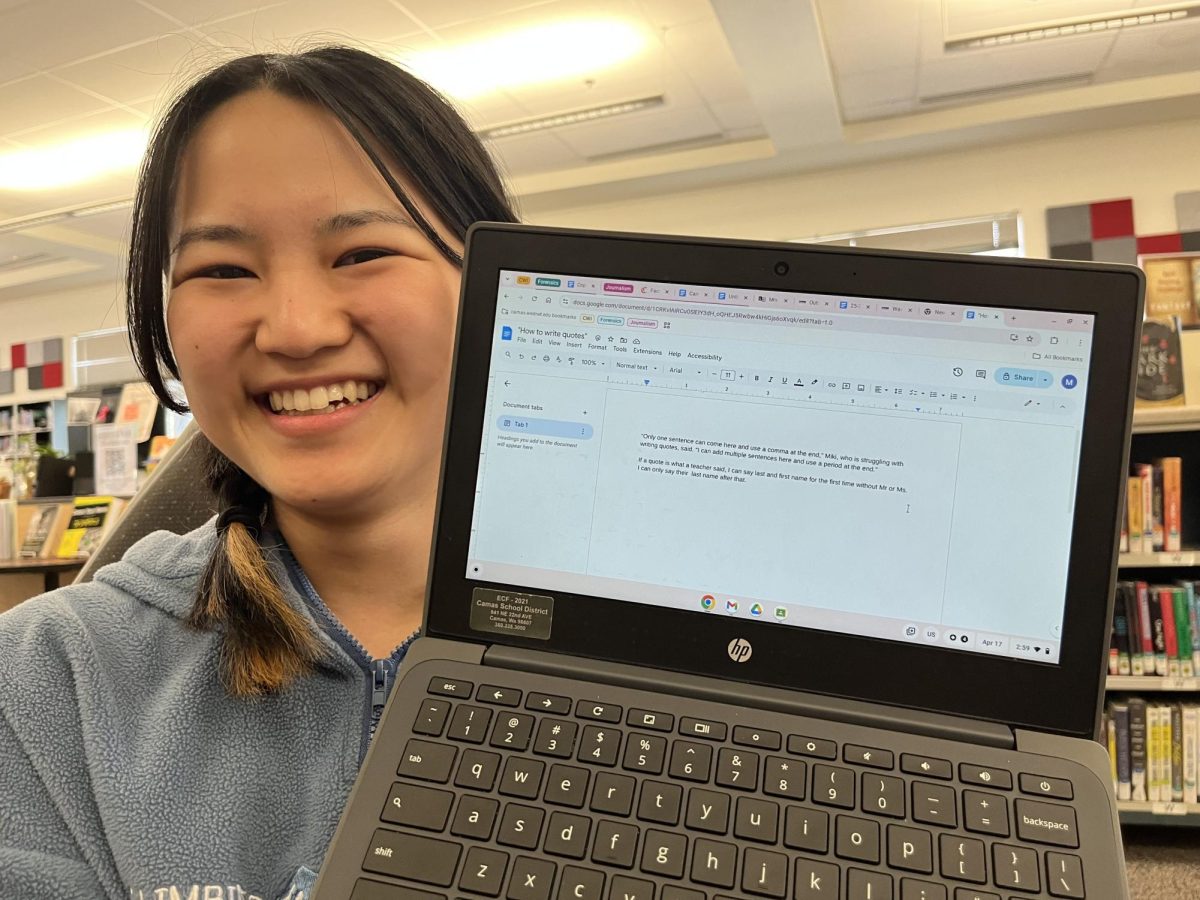




Seha Jang, a senior at Camas High School (CHS), dabbles in many extracurricular activities. She is known for her participation in the journalism class, as well as serving as the president of the National Honor Society (NHS) and journalism clubs at CHS.
“I’m always amazed at how much Seha is able to not only do, but be really good at,” CHS senior and editor-in-chief of the Camasonian Casey Leach said. “She’s really good at so many different things, and I find that very inspiring.”

Jang spends most of her time participating in extracurriculars and in art. From playing the violin to publishing her own book, Jang’s wide range of skills has resulted in her success today.
“My two goals in life when I was four were to be a ballerina or to be a violinist,” Jang said.
Jang’s prowess in the violin stemmed from when she lived in California as a young girl. While in California, Jang hung out with a very musically-inclined crowd, doing a lot of composition work due to the large number of opportunities.
“[She is] a violin beast,” CHS senior Inka Byman said. “I’m in the choir, and she does a lot of violin playing at our concerts.”
Jang played piano for 10 years. Although now she does not play, she recognizes the importance of how it shaped her musical upbringing. In addition to piano, Jang also became a published author in the fourth grade with the book Julian Gobbleton and the Great Turkey Escape, which she turned in for a Thanksgiving assignment. After receiving an F on the assignment from her not-very-kind English teacher, Jang’s English tutor encouraged her to publish the children’s book and not to be discouraged from writing. Jang drew all of the pictures herself, but after the tiresome project, she strayed away from drawing.

Following Jang’s move from California to Camas, her artistic direction shifted greatly. Jang took two research-based trips during the summer between sophomore and junior year. One of which was a trip to the New York Times Summer Academy Program, where she learned her love for learning about other cultures. In New York, she was assigned a project to identify certain microdiscriminations and legislative systematic discriminations. Through her project, she realized the weight of the unfairness of certain regulations on Asian cuisine in New York.
“Asian American restaurants would be targeted more because of stigma in the past,” Jang said. “I think that’s what made me really interested in the Native American struggle currently in the United States about federal recognition.”
In Jang’s other research trip to Poland, where she was a student teacher in English, she realized anyone could be subjected to discrimination.
“Particularly visiting Auschwitz—shaped my interest for archaeology and anthropology when I realized how non-discriminate history’s atrocities are to all humans.” Jang said. “In the ‘Canada storage room’, I discovered the Korean chipsin, traditional footwear worn during the Joseon Dynasty, and realized how powerful artefacts and material history are in helping bridge the gap between ‘his-story’ and ‘our stories.’”
When Jang joined the Key Club, she got involved with the Native American Parent Association, which would go on to inspire different research projects and, eventually, her senior project.
“I volunteered there for a while, and they taught me a lot about different perspectives on different traditions and native culture,” Jang said. “Different traditions, different types of art, music, medicine, food. Storytelling is a really big part too, and I find that interesting. The reason why I like art is because you could story-tell without using words or being explicit. There’s a certain beauty in the vagueness of it.”

Jang’s senior project focuses on Native American oral history with the help of her mentor, Dr. Sherrie Davis. She plans on using her artistic skills to convey the message by producing a
documentary highlighting how oral history lives today.
“Western institutions say that oral history isn’t counted as a credible source,” Jang said. “I didn’t want it to be like a political analysis essay; I want it to be more meaningful and more of a visual diary.”
Jang’s journey through the arts has made her especially interested in anthropology, history and, more specifically, how the arts have formed history.
“Art can tell a story without using words,” Jang said. “People didn’t really have to create anything in their recreational time, so whatever they choose to create says a lot about who they are.”


