





The College Board is a nonprofit organization founded in 1900 at Columbia University. It is known for standardized tests, including Advanced Placement (AP) exams, which have been offered since 1952.
Camas High School (CHS) began offering AP classes to encourage students to challenge themselves with a fast-paced curriculum and an intense learning environment.
Since 1952, AP classes have gone through several changes, including the shift to fully digital tests, shorter test durations, and the addition of built-in calculators. All of these changes were made based on user feedback to improve the student experience.
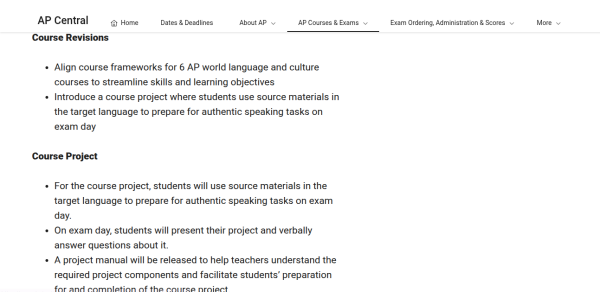
However, a major change is coming to the AP world language courses. The College Board plans to transform AP world language tests from standardized assessments to a project-based learning approach. This change particularly impacts Spanish classes, which account for the highest proportion of students taking a language at CHS.
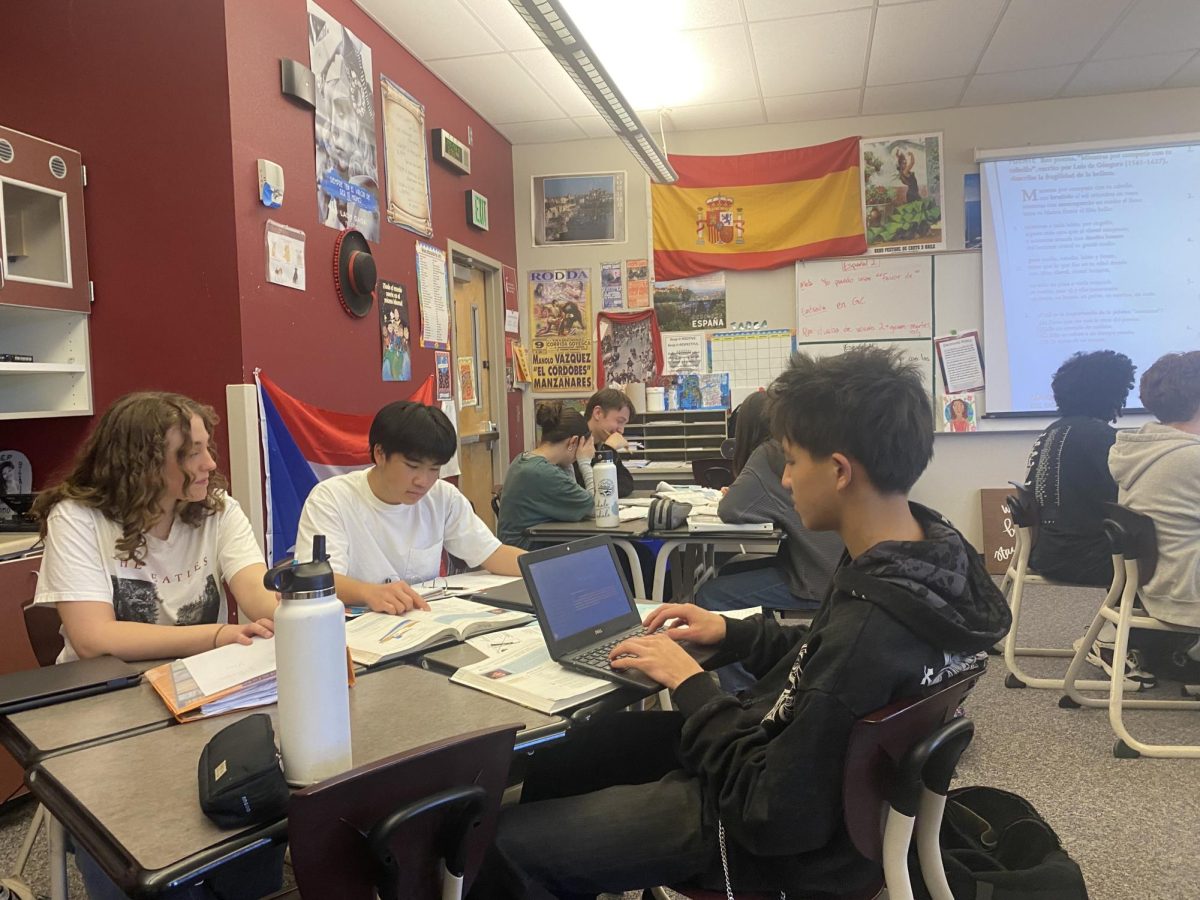
“I would imagine they’re moving toward [project-based learning] to give a stronger focus, and to level the playing field so that everyone has [the same information] going into the test,” Jamie Rodda, who teaches both AP Spanish 4 and Spanish 2, said.
“The College Board likes to focus on what kids are doing with this knowledge,” CHS Principal Kelly O’Rourke said. “You can read a book and be very smart, but at the end of the day, what are you doing with that knowledge? The College Board is trying to find a way to assess that.”
However, the exact changes to project-based learning remain somewhat vague.
“The AP tests will be based on the project; a couple of parts will stay the same, like the persuasive and argumentative essay, along with the multiple choice part,” Rodda said. “But I believe they’re getting rid of the cultural comparison and the simulated conversation piece.”
As of February, the College Board has officially set in stone a project-based learning strategy for AP Spanish, which will come into effect for the 2026–2027 school year. At the same time, CHS removed the AP Spanish curriculum from its coursework, meaning that students can no longer forecast for AP Spanish in the upcoming school year. Instead, the University of Washington (UW) Spanish 3 will replace it, and the year after that, UW Spanish 4 will be offered.
“Financially, it is very expensive [to offer AP Spanish as] one year you might have a decent class size, [and] the next year you’ll have five kids. [It has the potential to take funding] from all the other classes,” O’Rourke said. “There were already conversations years ago over how long we could sustain AP Spanish.”
Not only is AP Spanish expensive to maintain, but some students have also run into issues when it comes to actually acquiring the college credits from the class.
“We’ve seen over the years that not all colleges are using AP classes for college credit. They’re using it to place [students], but they’re not necessarily accepting it as a college credit,” O’Rourke said. “That’s a dilemma for kids, they’re taking these hard courses and some of them are going to benefit them and some of them are preparing them for the rigor.”
There is some confusion surrounding this change, with lots of it revolving around how students going to college will be affected.
“[When it comes to] UW or Central Washington University [CWU] credits, sometimes people think that’s the only place people can use those credits. But those are full-fledged college credits that if you went to Idaho or Montana, colleges are going to take those as transfer credits,” O’Rourke said. “By offering dual credits like CWU Chemistry or [CWU] English, helps [students financially] by taking those classes before they head off to college.”
Furthermore, there has been an intense debate and controversy surrounding these changes, as the curriculum becomes more challenging for teachers to teach, while forcing students to adapt to the new developments.
“I do think some of these changes could make the class a lot more difficult to teach, [as we now have to] get students ready with the project, especially [since we’re] in the era of ChatGPT and AI,” Rodda said.
“I was a former AP high school student; I’ve always been a pretty big fan of AP,” Rodda said. “Ultimately the most important to me is that [the students] get what they’re the most passionate about.”
Additionally, since the school has decided to steer away from AP Spanish 4 and only UW Spanish 3 will be offered next year, current Spanish 2 and Spanish 3 students will be in the same class next year, should they continue with their language pathway. Moving from Spanish 2 to Spanish 3 is a far jump in vocabulary, grammar, and cultural knowledge, which has caused many students to be worried.
“We can probably take the Spanish 2 kids up to the level where the Spanish 3 students are,” Rodda said. “I don’t think they’ll have to learn many new grammar concepts, but for [Spanish 3 students], it would be about reinforcing what they’ve already learned and examining it more deeply.”
Over the years, the College Board has made its tests significantly easier, with pass rates increasing from around 50% to 70% in most courses. AP Spanish often has lower pass rates due to the difficulty of learning a new language. Many students fear that if the College Board continues to lighten the test load, colleges might value rigorous courses like AP Spanish less, erasing the work students have put into the class.
“In this particular case, the pass rates [had nothing to do with our decision to remove AP Spanish],” O’Rourke said.
Although CHS is transitioning away from AP to a college in the high school program, O’Rourke believes the curriculum is still capable of challenging students while also offering benefits that may not have been present in the AP Spanish class.
“For Spanish 3 [students], it was overwhelming that kids would [be more likely] to take a fourth year of Spanish if it was at UW. [This is for students who] like Spanish but are already taking so many [difficult classes] and don’t want the rigor of another AP class. We like for kids to take four years of Spanish, if able,” O’Rourke said. “There’s a lot more culture, involvement, and activities, instead of the very high expectations of AP.”
Opinions differ among students, as many, especially those in AP Spanish 4, want to stay loyal to the current curriculum.
“I’m definitely in favor of AP Spanish because the AP curriculum includes some very helpful life skills, which go beyond just vocabulary and grammar to learning how to apply them,” Lily Atalla, a CHS senior currently taking AP Spanish 4, said. “I don’t know if [UW’s] Spanish 3 would necessarily have those skills.”
In contrast, many students in Spanish 3 would prefer to earn credits through UW, which the majority of students at CHS apply to.
“It sounds like a good opportunity for [students] to learn without the fear of a score hanging over them,” Genova Michaelson, a CHS senior taking Spanish 3, said. “I [hope students] will see Spanish as something to learn and [apply] rather than just memorize, especially if it’s not tied to an exam.”