







This year, Camas High School (CHS) has been cracking down on attendance, attempting to get students in line after past years of relatively lenient enforcement of attendance policy. This adjustment has been a point of confusion among both students and teachers who are still getting used to the new system.
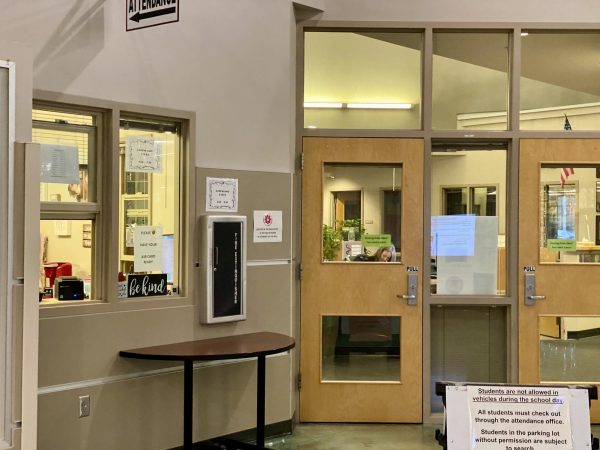
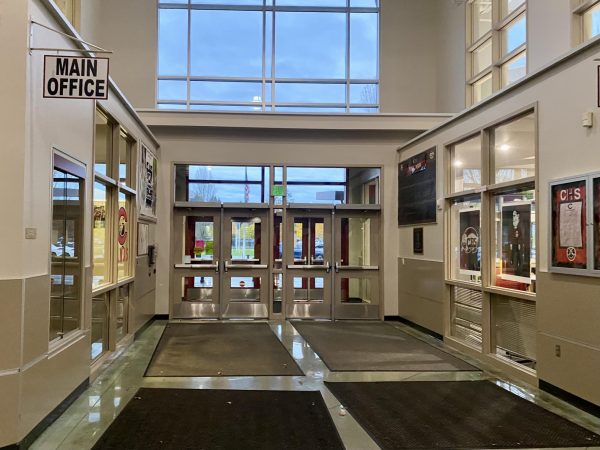
The most recent change has been for students arriving at school in the morning. Instead of the previous unofficial grace period for students who walk in seconds after the bell, any student who walks in through the main entrance after the bell is immediately redirected by staff to the attendance window, where they must check in before going to class.
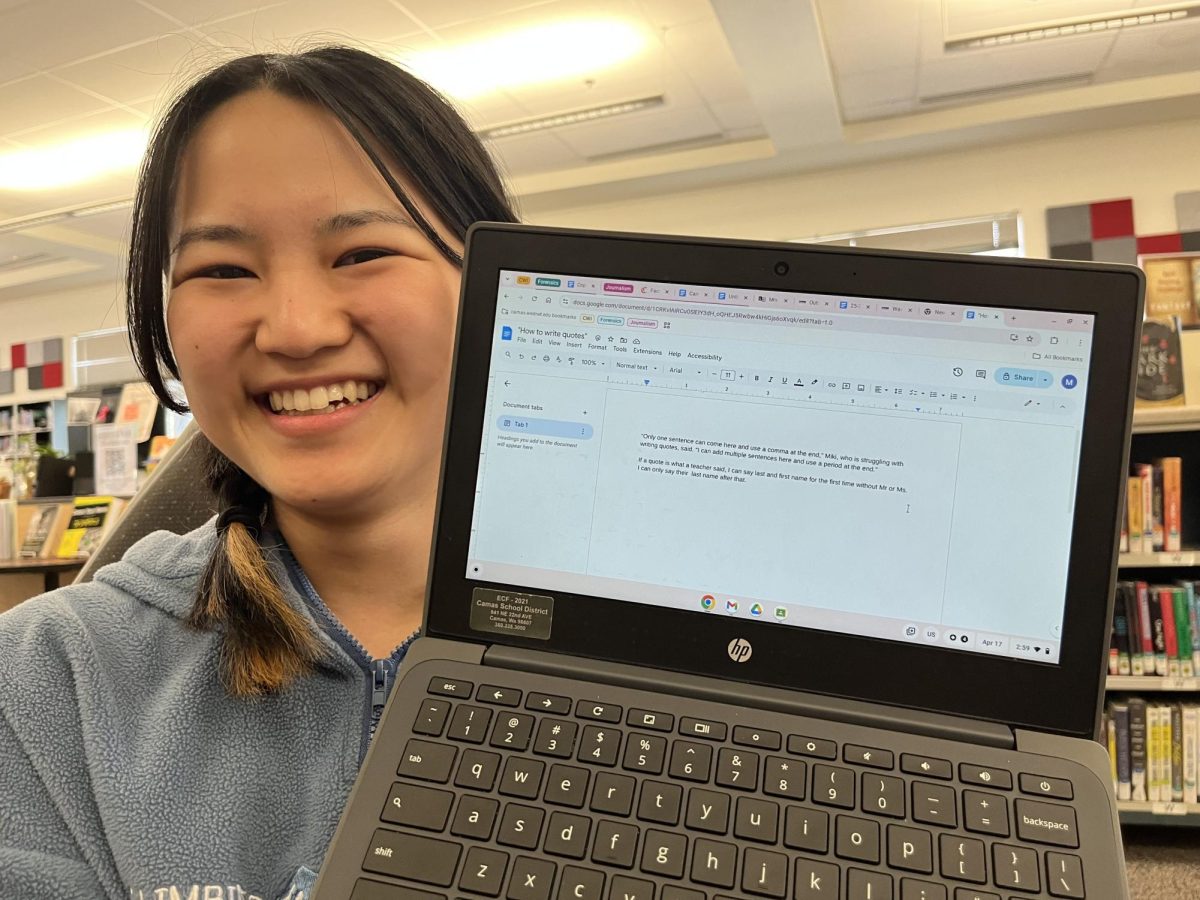
“I would get to school … when the bell rings, but then there’d be a long line, and instead of being one minute late to class, I’d end up being six minutes late,” Yvonne Yin, a senior at CHS, said.
When enforced, this policy has led to countless students walking into class five minutes late, tardy pass in hand, after entering the building just moments after the bell.
“What we’re seeing now is that they’re locking the outside doors at 8:45 on the nose, which makes the only entrance for people to come in and out the front entrance,” attendance clerk Earleen Martin said, “…and because of that, we are stopping students and making them sign in [when] they’re past that 8:45 cutoff.”
Of course, it cannot be denied that students are arriving later to class, but Martin believes that it is a way to push students to arrive earlier.
“I understand that some students are concerned because having to wait in the line to check in is actually making them later, which is a fact,” Martin said, “but it wouldn’t exist if you were here on time … you can’t just roll up when you roll up; you’ve got to be on time.”
Aside from the reassertion of existing tardy rules, CHS has also made some alterations to SST time — a work period for students between 10:36 a.m. and 11:01 a.m. Now, students who do not forecast for an activity are placed into a classroom based on factors such as their typical SST locations and classroom availability.
However, some students have found this system to be unreliable, such as in the case of Aria Bent, a senior at CHS.
“It was SST, and I had forgotten to choose a location for myself, so I went in expecting to see one of my regular classes …” Bent said. “Instead, I was put into Jesus Club.”
As a nonmember, Aria was surprised to see she had been assigned to a club she had neither attended nor been a part of.
Other students have reported issues with signing in or trouble with the system, although there has been some improvement as the year has progressed.
CHS has also been cracking down on students who appear to have skipped class. Whether that be genuine, a substitute slip-up, or human error, all students who miss a period will be served with a single-period absence slip. These slips must be signed by the teacher, stating the reason for the absence, before being returned to the office. According to Martin, these types of forms have existed before, but CHS Associate Principal Owen Sanford has only recently initiated their use within the building.
If not returned by a set date, the respective student can look forward to lunch detention and, if the behavior continues, Saturday school.
“That has to do with the focus being on students who are skipping single-period classes and being held accountable for that,” Martin said.
As a result of these new policies, there has been a sharp increase in the number of students being assigned detention weekly compared to last year.
“On a weekly basis … 25 [detentions weekly],” Martin said. “It’s definitely more because we were not enforcing the single-period absence.”
Office attendees, occasionally responsible for handing out the detentions, have noticed the uptick as well.
“It’s really going up a lot … just within the past few weeks I’ve been handing out a lot of [detention slips],” Gigi Woodriff, sixth-period office TA, said. “I think it’s mostly just tardies … we have really busy parking lots; it’s really easy to get one of those first period. I think tardies should be given a little more leeway.”
“The consequences are not proportionate to this misdemeanor,” Yin said.
As the school year continues, both students and staff are learning to work with the new system. Whether through digital passes, scannable codes, or improved systems, CHS may still be searching for a balance between accountability and understanding.