







Fake news is becoming an increasingly serious problem for students around the world, due to the increase of unverified news sources and false social media posts. Even at Camas High School (CHS), students often misjudge what they see online.
There are many different tools that students and teachers can use to authenticate what they consume, but they are not always perfect. Jeanne Jarvis, an Honors English and AP World History teacher at CHS, has some tips that she shared with her students.
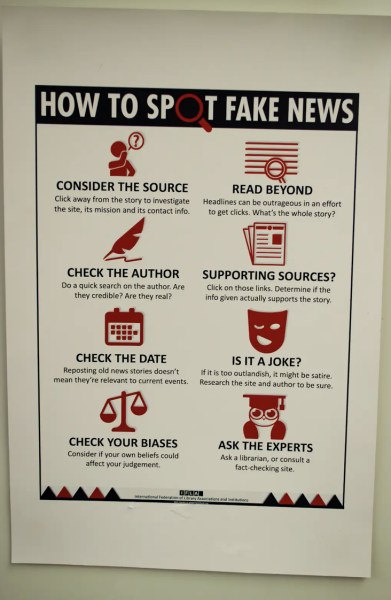
“[First, you should] understand the concepts of disinformation (deliberately false) and misinformation (inaccurate but not intended to deceive). [Another tip is to,] Test out news sites by using the “CRAAP” Test: […] Currency, Relevance, Authority, Accuracy, [and] Purpose/Position,” Jarvis said.
For many students, it is a struggle to find reliable, unbiased news sources, which contributes to a clear lack of understanding about current events. According to the Institute for Public Relations (IPR), around 80% of Americans come across false news at least once a week.
Furthermore, the vast majority of high school students use social media, which has been found to be a key source in spreading false information. The IPR states that, “Facebook (74%), TikTok (67%), and X (67%) are considered the most responsible platforms for spreading disinformation.”
If students continue to depend on such social media platforms for their news feed, they may become more vulnerable to misinformation and have less of a chance to recognize it. CHS junior Addison Hawkins comments on how dangerous this can be.
“I think a lot of students will simply believe [that] the first thing they see is factual when that’s not the world we live in today. Then students come to school and tell their friends about the article they think is real but is false and thus it spreads like a wildfire,” Hawkins said.
Additionally, with Artificial Intelligence (AI) becoming more sophisticated in generating fake images and videos, making it harder to confirm the accuracy of videos and images.
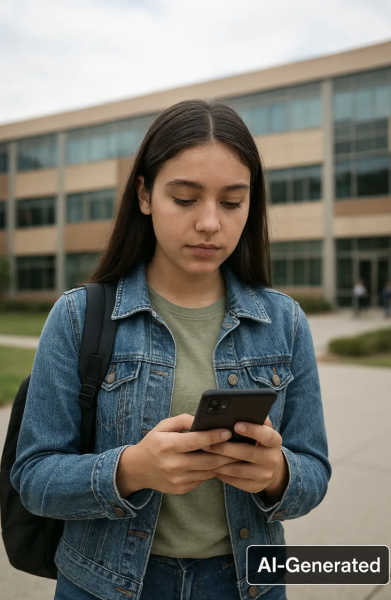
The recent release of OpenAI’s Sora 2 has further complicated the matter by giving users the ability to create almost lifelike videos that are often indistinguishable from real footage.
Henry Butler, a freshman at CHS comments that he can usually tell when an image is AI-generated, but some AI images are too hard to evaluate.
“But when I can’t [tell if it is fake], I don’t think anyone else could unless they spent a while examining it.” Butler said.
AI-generated images are becoming more prevalent on social media, and it is becoming more of a threat—especially when the user presents it as real content. More and more students are reporting that they’ve been misled by AI-generated content.
“I often find myself not knowing the difference between AI and real photos,” Hawkins said.
As these AI tools continue to adapt and get better, educators will …educators will have fewer reliable ways to verify student work—and even less time to keep up.“[Conforming authentication] is a near-impossible task, but we used to have a pretty decent program called turnitin.com, [although] due to budget constraints, we are no longer able to use it. Instead, there are some free ‘AI Checkers,’ but even those are not totally reliable. Things are changing way too fast,” Jarvis said.
