







Saturday, July 19
My family takes a trip to Neskowin—a small town on the Oregon coast—in late July every year. Most people go into vacations energized. My family has always been of the mindset that it is best to enter into a trip completely exhausted — or else it seems we somehow always are, coincidentally. My father, who works as a fire weather meteorologist, is never as burnt out as he is in the late summer. I used to rarely see him in these months when we lived amongst the flames of California. Now we make an effort to get him away from work every year and onto the stony beaches of the Oregon coast.
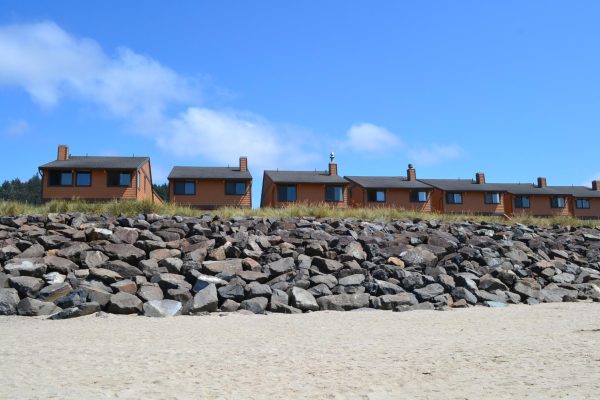
The town of Neskowin is quaint and private, mostly consisting of families and retired people with the common goal of getting away from the hustle and bustle of the modern world. Compared to neighboring tourist destinations on the Oregon coast, Neskowin is relatively quiet. The town is so small that it lacks a post office, which proved to be problematic when I tried to send my colleague and friend Seha Jang a postcard detailing my travels.
Joseph Farland, my third period AP Language & Composition teacher last year, told us his favorite part of any vacation was visiting the local supermarket. He talked about examining the layout of the store, the stores adjoining it in the outlet, the parking lot, the outside. He looks for differences in the people shopping. My father and I also do this upon landing at our travel destination, although perhaps more for function than fun. We had to stock our empty fridge with food for our vacation, including way more ice cream than we could possibly expect to eat across five days. Going to the store was not easy, however. The nearest supermarket to Neskowin is a Safeway in Lincoln City, about a fifteen minute drive away. Every time we went out to get something (which was quite a few times — it seemed like every time we came back from the store, we realized we forgot something), it would be a lengthy ordeal. By the time we had gone and returned from Safeway, it was around 8 p.m.. We were exhausted from a day of driving and still had not had dinner. I tried to make a breakfast burrito. It was much more work than it was worth.
Sunday, July 20
I began working out consistently around the beginning of July — something I never thought I would do. I have always hated exercising, but I began to realize the importance of strengthening my muscles so that I would be able to do things I enjoy doing, specifically walking very far distances on the beach. Last year, I walked six miles spontaneously during our vacation, which completely wrecked my legs for the rest of the trip. I started walking most days of the week in order to strengthen my legs for my long beach walks this year.
My effort ended up paying off. On Sunday, I walked five miles across the beach with little to no pain. It may not seem like much, but keep in mind that I was walking on sand, which is much more difficult than solid ground.
The first time we came to Neskowin, my dad found these shoe coverings for the beach and bought a couple of pairs for us. I call them, affectionately, Space Boots. They are waterproof and prevent our shoes from getting all sandy, allowing me to wear my tennis shoes when I’m walking great distances yet still maintain a relative level of comfort that I would not have if they were wet and full of sand. But they look like astronaut gear, it’s true. I always get a good chuckle out of seeing people looking at my shoes and trying to figure out what on earth they are.
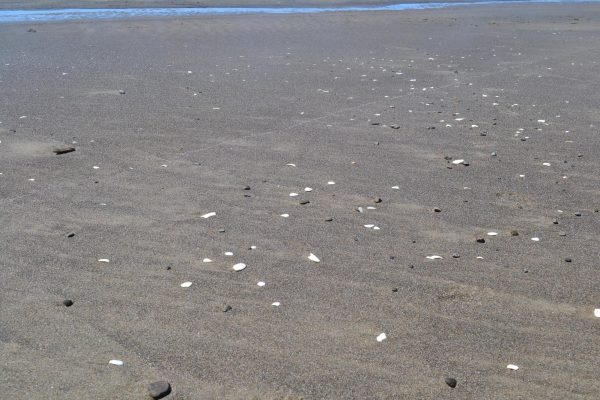
My beach-walking habit came from a beach-combing habit. During our earliest vacations on the Oregon coast, I quickly found myself enamored with the beautiful stones that line the beaches. I spent hours hunched over, gathering rocks and getting horrible sunburns without realizing it. I would return back to my parents several pounds heavier due to the rocks in my pockets. This is still a dear habit of mine. I make an effort to wake up early whenever I’m on vacation and catch the low tide when the most rocks are visible and nobody has combed through them yet. We have bags upon bags of sea stones stored throughout our house and on display.
Within the past year, I have begun tumbling rocks that I take home from the beach. A large part of the appeal of beach-combing is the idea that you can find a shiny trinket and take it home at no cost to you. These smooth, sparkling rocks have already been tumbled naturally by the ocean waves and gritty sand. Having my own rock tumbler allows me to make use of the more jagged but still beautiful rocks often left behind by beachcombers.
Monday, July 21
My dad and I woke up at 7:30 to go kayaking in Cape Meares, a small place about 45 minutes north of Neskowin. We were supposed to leave by 8:30 in order to get there early, but in typical Leach fashion we left the house around 9:00. We spotted a rack of kayaks on the side of the road and my dad skidded to a stop in the gravel at 9:58 — two minutes before our tour.
Our guide was Sydney Elliott — or Syd, as she introduced herself to us. A kind and considerate woman, Elliott has worked as a kayak guide for six years. She bought the company she worked for three years ago and has continued to work as a guide ever since.
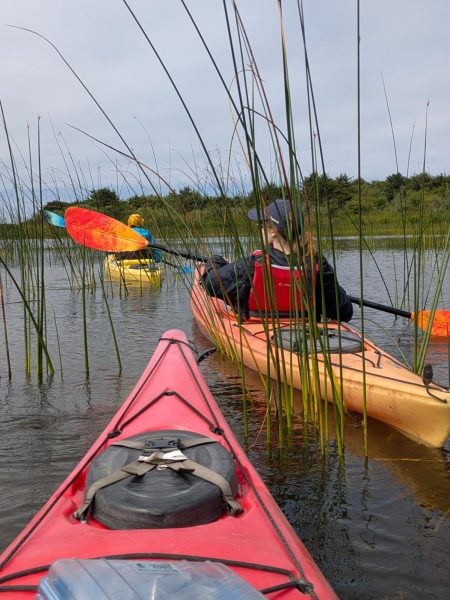
Elliott helped my dad and I as we awkwardly stumbled our way into the kayaks. She demonstrated how to row the oar in order to turn and go backwards, as well as how to move in order to not strain ourselves more than we had to. Once we got out onto the lake, I found that kayaking was not quite as intuitive as I assumed it would be. I had little grasp of where my boat was at any given point and was more or less steering into the reeds and getting myself stuck.
As I struggled to keep my kayak on track, Elliott conversed with my dad about his job. She seemed genuinely curious to hear what my dad had to say about fire fuels and such. When I began to get a hold of things, Elliott asked me what grade I was going into and my plans following high school. I told her I planned on going to college and studying to become a journalist.
“No kidding!” Elliott said. “Go humanities!”
Elliott then told me she teaches at Oregon State and Tillamook Bay Community College. She also is the National Publications Director of the Community College Humanities Association and serves as the editor for the Community College Humanities Review. When she isn’t doing any of those things, she works as the leader of a volunteer search and rescue group. I was astonished that anybody could do so much.
“I believe that the real key to happiness is being curious and asking questions and challenging ourselves to try new things. The most important part is not being afraid to fail,” Elliott said. “I think we worry too much about not being successful that we won’t try something that might bring [us] absolute joy and contentment.”
The best advice anyone ever gave Elliott was to learn something new every year — to step outside of your comfort zone and try something you would never do otherwise. She has tried knitting, boxing, and even belly dancing. Currently, Elliott is writing a book about her elusive grandmother whose existence she only recently discovered after signing up for 23andme.
I imagine Elliott took a liking to my dad and I because we were following her philosophy and trying something new. I am not sportsy at all; I never thought I would go kayaking. When my dad brought up the idea, I thought “well sure, why not?”. I assumed kayaking would be easy because it looks easy — drifting out on calm open waters in a boat, nothing more. Kayaking, however, is much more complex. You have to have considerable arm strength in order to keep the boat from drifting. Even more so you must have endurance, as we spent about two hours out on the lake. You also need decent motor skills. It’s a bit like driving — it becomes intuitive once you know what steering a certain way will do to your vehicle.
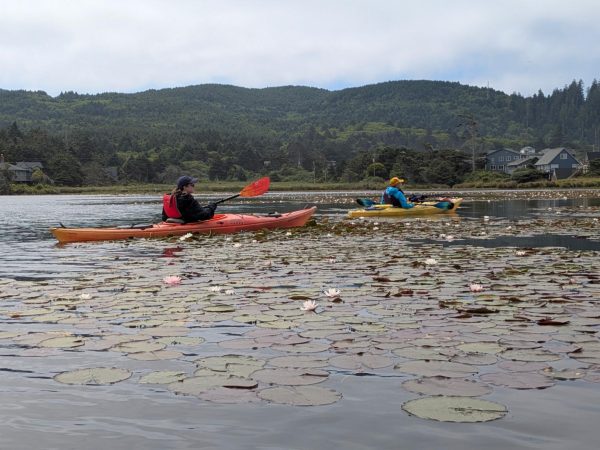
As we paddled across the lake, Elliott pointed out various birds to my dad and me. It was a calm, clear day on the Oregon coast. Herons and egrets populated the trees on the edges of the lake and remnants of beaver dwellings stood among the reeds. We even drifted into a grove of water lilies. Even though I’ve never been particularly enthralled by nature, I found the experience of kayaking on Cape Meares Lake to be entrancing.
“Water is the great equalizer. It tends to bring peace to people,” Elliott said. “I get to meet people from all over the world and see their reactions to nature — sometimes children seeing their first water lily or bald eagle.”
By the end of our trip around the lake, I felt a sense of serenity that Elliott said is common of the people she goes for kayak tours with. But it wasn’t just the lake that calmed me. My conversation with Elliott — about the humanities, about integrity, about life and happiness — seemed to simplify life.
“What we know from literature — hundreds and hundreds of years of literature and storytelling — is that money cannot buy happiness,” Elliott said. “There has to be something else that feeds who we are.”
Tuesday, July 22
Just across the road from the little enclave of houses we stayed in is a small art gallery owned and operated by local artist Michael Schlicting. I had intended to visit the gallery for years, but never actually got around to it until this trip.
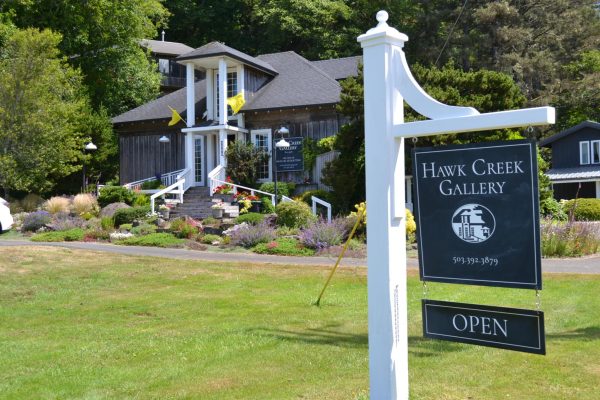
Schlicting has been an artist for 48 years. He moved to Illinois to play basketball in college after growing up in Neskowin. Although his mother was an artist, Schlicting had not considered a career in art until taking a mandatory college art class.
“The first time I walked into the studio, it just felt like home,” Schlicting said.
In the beginning of his career, Schlicting lacked the innate artistic ability that many artists are assumed to have. He understood composition, however, and felt comfortable working creatively. Like basketball, art requires consistent effort and devotion to the craft in order to improve. This is, in part, what drove Schlicting towards the arts.
“The process and the end result — a game or a finished painting — is really just a byproduct of that joyous practice,’ Schlicting said.
Schlicting got married straight out of high school and decided to try to make it as an artist. After trying to sell art in fairs across Colorado, Schlicting grew tired of the area and decided to move back to the Oregon coast where his brother was working. His parents owned a small building that had once been a schoolhouse on the Neskowin coast and decided to offer it to him for the summer.
This building eventually became the Hawk Creek Gallery.
On Memorial Day weekend of 1978, Schlicting put his art up in the schoolhouse and set out a sign on Highway 101 advertising an art gallery.
“People came and bought stuff and I thought ‘Wow, this is better than setting up on a sidewalk every weekend,” Schlicting said.
By the end of the summer, Schlicting had begun making enough money from the gallery to start a business out of it — so he did.
Schlicting has opened the Hawk Creek Gallery every April through October for 47 years. The gallery is a staple of Neskowin, appearing on lists of Oregon coast activities and even recently landing Schlicting on the front page of the Oregonian. His semi-celebrity status in the area has not detracted from his personability, however. When the gallery is open, Schlicting spends most of his time speaking to visitors about his art and answering questions. On the rare occasion that he is away, Schlicting leaves out a notepad and pen for people to leave their emails and phone numbers for him to get back to.
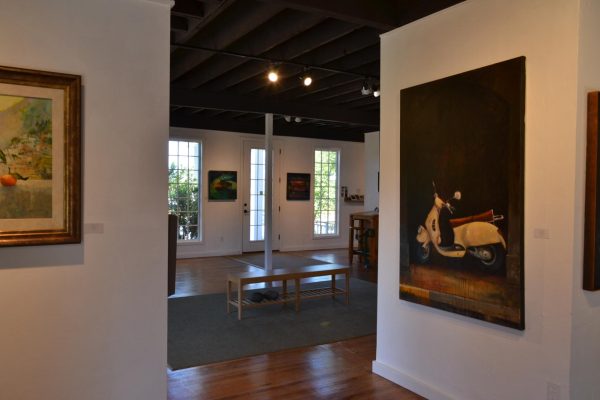
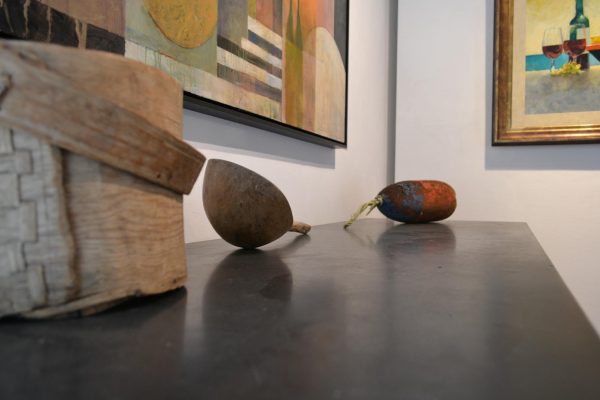
Schlicting was unfortunately away when I visited the gallery, but I still got to see how his art enchanted people. In the short time I was there, a wide range of ages, both tourists and locals, visited the gallery. An old couple purchased and took home a beautiful original painting. I was tempted to buy one myself.
Most of the paintings displayed at the Hawk Creek Gallery feature scenes from the Oregon coast. I was reminded of my own trips across the beach as I looked at his depictions of driftwood that I often pass during my walks. Some of his paintings feature landmarks more specific to Neskowin such as Proposal Rock and the Ghost Forest.
“My beach paintings are [mostly] the inner tidal zone between the water — the cliffs, the sand, the rivulets,” Schlicting said. “Sometimes the ocean makes an appearance, but [my paintings] are more the architecture of the beach.”
Architecture plays a strong role in Schlicting’s works. Beyond the Oregon coast, he portrays archways, stairwells, and bridges from his travels across the world. Most of Schlicting’s works have a unique geometric composition to them that sometimes gives them a surrealistic feel.
“Even on my landscape paintings, to make them more interesting for me, I will arbitrarily create vertical or horizontal divisions. Sometimes they are more pronounced, sometimes subtler,” Schlicting said. “I’m not interested in just replicating.”
There is a definite emotional component to the subjects of Schlicting’s paintings — something that becomes obvious when you enter the Hawk Creek Gallery. Brightly colored seascapes line the wall of the gallery as an homage to the beautiful area Schlicting grew up in. On the Hawk Creek Gallery website, these paintings are labeled as “Home”.
For the past couple of years, Schlicting has worked on collecting historical photographs of Neskowin to publish in a book. The book, called Neskowin: A Book of Found Photos, originated from Schlicting’s wish to find photos of the Hawk Creek Gallery back when it was a schoolhouse. After posting on Facebook about it, someone reached out to him with family photo albums from the 1880s.
“My wife and I were looking through these albums and saying ‘Man, there’s so many cool photos in here that no one has ever seen’,” Schlicting said.
Schlicting and his wife, Jody, created the Neskowin Historical Foundation to gather together a group of people to search for more historical pictures of Neskowin to compile them into a book. After two and a half years of work, the book is set to be available for purchase in October of this year.
To the Neskowin community, Schlicting is much more than just an artist. The Hawk Creek Gallery and his stunning artwork draw people to the town, exposing them to the hidden gem that is Neskowin.
“Usually, at least once or twice a week, someone will come in and say ‘we were just driving by and we had to do a u-turn to see what was here’,” Schlicting said.
Schlicting says he is merely a part of the larger community that allows Neskowin to thrive, using his niche to do his part in sharing the beauty of Neskowin.
“It’s a positive thing — people don’t know what they’re going to find, but they want to stop and see.”
Wednesday, July 23
My mom always schedules a horseback riding session on the beach whenever we are in Neskowin. This year was my third time riding with M&R Beach Rides, a small family-owned business in Pacific City, OR, that takes people on tours across the coast on horseback. They use their own horses that have been trained for trail riding and assign them to riders based on their experience with horses or, as is written on their website, “try to match [the rider’s] personality with the horse.”
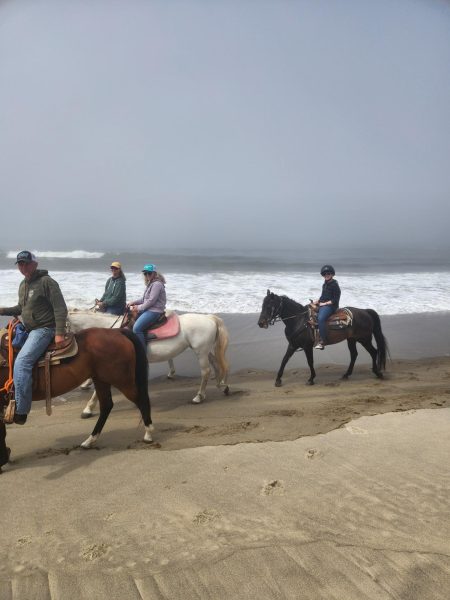
For someone who has never lived in a particularly rural area, I have quite a bit of experience with horses. I began horse riding lessons when I was about five years old. I quickly grew to love interacting with horses, these giant majestic beasts that have more in common with dogs than you would initially think.
M&R Beach Rides hosts one hour, two hour, and sunset rides, each varying in difficulty. We chose the one hour ride. Not only is this the easiest, but it also is the least painful, as riding on a horse tends to hurt if you are not used to it. Whenever my mom schedules our horse-riding trip, she makes sure it is at the end of our vacation, as we both tend to be sore for the following few days.
The one hour tour begins in a grove of coastal trees, which the horses are trained to skillfully navigate through. Riders still have to pay attention to their surroundings, as tall ones could easily hit their head on branches if they are not careful. At a mere five foot three, I did not experience this problem.
After a while in the forest, the trail takes the horses over the sand dunes that line the beach. This is perhaps the most challenging part of the ride, as the horses go up and down steep hills of sand. Still, the tour guides instruct the riders on how to lean in order to safely scale the hills.
Once the horses cross the dunes, they walk along the beach for about half an hour. This gives riders a different perspective of the coast than they may have gotten otherwise. For me, it gives me more of an opportunity to look up. When I walk along the beach, I look down, scanning the ground for shiny rocks and shells. On a horse, it gives you more of a chance to actually look at the ocean in motion, to take in the scenery, and to think deeply about the land around you.
I tend to take this time to reflect on my trip.
Each year, Neskowin comes and goes so quickly. The trip sneaks up on me and then ends just as suddenly. I only remember the place in times of trouble. During particularly busy weeks at school, I find myself thinking “if only I could go back there now and just walk.” The beach, sprawling cliffs and lapping waves, are infinite. Infinite time to be spent there, infinite times I will find myself on the twisty turns rolling back. Neskowin is exactly what it needs to be: there. Quiet, dormant, and always there, always able to go back to. I’ll see you next year.
